Start with the creative job: product entrance or performance?
makespots is a useful Arcads alternative when the missing part of the ad is its visual concept. A product can enter through a reveal, sit in a distinctive scene, or appear in a hands-led demonstration. The library lets you compare those directions before you prepare the generation inputs. You are choosing what the creative does, then supplying the product that belongs in it.
Arcads deserves consideration when the message depends on a speaker: a different delivery, a new presenter, a localized voice, or another reading of the same hook. Its public documentation describes actor selection, script direction, product interactions, and variations. Its current website also presents model tools and a workflow canvas, so it would be inaccurate to reduce it to a talking-head generator.
For a physical product launch, compare a reveal and a spoken explanation as separate creative jobs. For a subscription app whose story is mostly verbal, actor delivery may be the more relevant first test. A useful alternative should change the part of production you need to improve, rather than simply replace one subscription with another.
 Choose makespots for
Find a product reveal, UGC-style scene, or image format, then adapt its visible workflow.
 Consider Arcads for
Direct actors, delivery, voices, and ad workflows when the performance carries the message.
Official sources:Arcads platformArcads: AI UGC Ads
See where makespots and Arcads begin
In the makespots screenshot, the first decision is the example: you can see the product scene, motion treatment, or presenter format and open a corresponding workflow. That makes discovery concrete. A founder can point to the kind of ad they want before the team spends time writing an elaborate prompt.
Arcads’ public presentation puts its AI actors and creation tools in the foreground. Use that as the beginning of a product evaluation, not as proof that every performance will fit your script. The important follow-up is whether the actor, setting, pacing, and product moment can support the specific message you need to communicate.
Template library · real product interface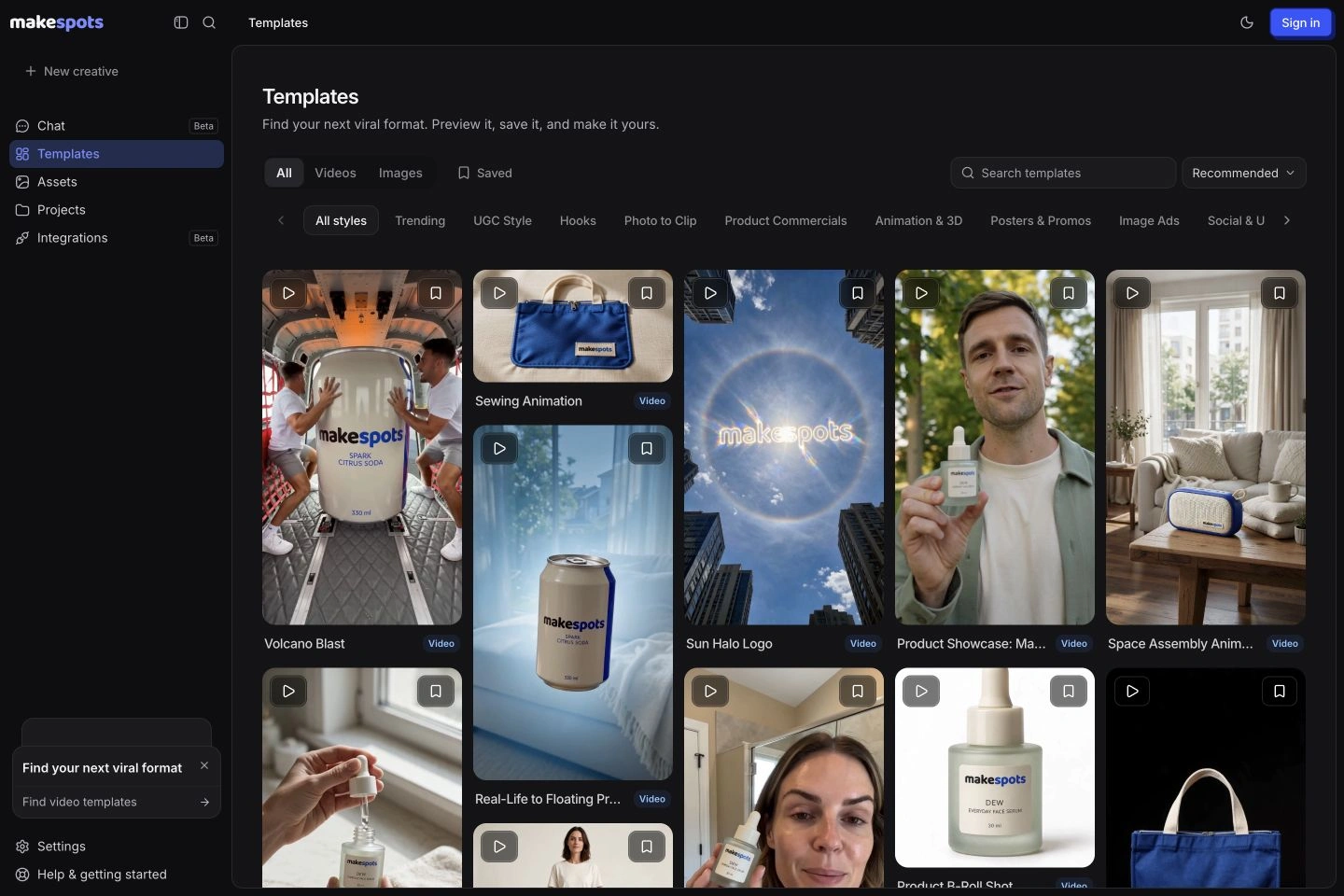 Official public product page
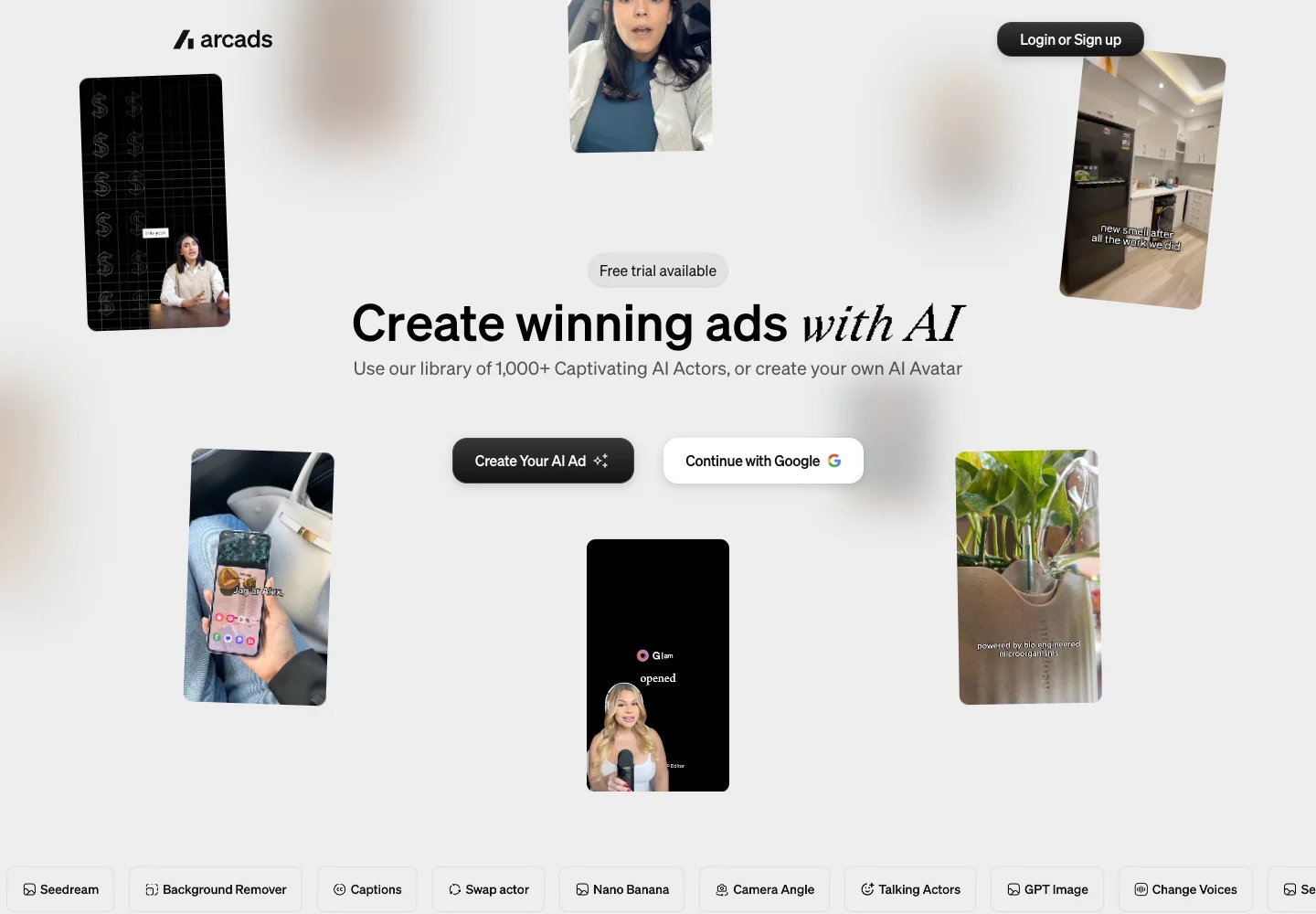
Competitor capture reviewed November 10, 2026. Open a screenshot to inspect it at full size. Public-page visuals illustrate the advertised workflow; they are distinct from a generated-output benchmark.
makespots vs. Arcads: the practical differences
Both products now cover more than one ad style. Compare the starting point, the editable parts of the creative, and the production requirements you would miss after switching. The table describes publicly documented capabilities; the sections below explain what those differences mean in an actual brief.
| What matters | | |
|---|---|---|
| Starting point | A visible ad template and its required product inputs. | Actors, scripts, model tools, and ad workflows. |
| Product-led formats | Reveals, UGC-style scenes, animations, and image ads. | Product interactions, app displays, presets, and model-based creation. |
| Actor direction | Controls vary by published UGC template. | Actor filters, emotion and pause direction, voices and accents. |
| Workflow canvas | Editable template steps and project inputs. | An infinite workflow canvas; Creator and above per public help. |
| Custom actors | No equivalent custom-actor library is established here. | Custom-actor slots vary by plan; unlimited on Pro and above in the help matrix. |
| API and teams | Evaluate the current workspace against your production needs. | Public API and team seats are documented for Pro and above. |
| Pricing evidence | Live monthly plan configuration and workspace generation quote. | Public plan credits and tool rates; subscription dollar quote in the app. |
Official sources:Arcads platformArcads: AI UGC AdsArcads plans and credits
When the person is the creative, inspect the performance controls
Arcads documents actor filters for characteristics and settings, emotion and pause direction in scripts, and voice choices by language and accent. These are relevant when the same sentence needs to feel like a different recommendation. A calm product explanation and an excited discovery can use similar words but communicate very different expectations.
makespots includes UGC-style templates, but choosing one is a format decision. Read the individual template guide to see what dialogue, setting, reference, or product-action controls are available. Do not assume that every template can provide the same custom-actor system, voice behavior, or performer range as a specialist actor workflow.
For a first evaluation, choose two short openings and keep the product claim identical. Review pronunciation, mouth movement, breath spacing, and whether the delivery sounds like someone explaining a useful thing. If your script is hard to say naturally, rewrite it before attributing the problem to the video model. A more believable performer cannot rescue a confusing promise.
Official sources:Arcads: AI UGC Ads
A visual product moment can do work that dialogue cannot
A reveal makes the product’s entrance the event. A close product scene can make the material, packaging, or silhouette easier to recognize. A hands-led sequence can put a familiar action around the object. These are distinct creative mechanisms, and makespots exposes them through template previews rather than asking you to invent all of them from a blank brief.
Arcads also documents putting a product in an actor’s hands and showing an app on screen. That is valuable when a demonstration is part of the person’s recommendation. The useful distinction is not that one tool can show products and the other cannot; it is whether you want the product’s scene or the performer’s delivery to organize the ad.
Consider an insulated bottle. An actor can explain why they carry it, while a reveal can establish the object as the visual centerpiece. If both are needed, use the same approved reference and keep the product facts consistent across the pieces. Check the cap, label, scale, and grip in every generated interaction before treating the result as a demonstration.
Official sources:Arcads: AI UGC Ads
Compare the second version, not just the first render
A makespots template opens into an editable workflow with its inputs and creative steps. Keep the source references in the project, change the relevant direction, and duplicate the project before exploring another treatment. This is useful when you want a visual format you can understand and revisit rather than an isolated finished clip.
Arcads’ current website describes an infinite workflow canvas, and its help center places Workflows on Creator and higher plans. That means workflow editing is an overlap to investigate, not a makespots-exclusive claim. Compare how each environment handles your particular inputs, which operations the selected plan unlocks, and how clearly the team can identify what changed.
Make the same revision in both: keep the product and offer, replace the opening, and preserve the approved ending. Record whether you can reuse the good material or need to generate more of the piece. The practical value of a workflow appears in the amount of control you retain when the initial idea is almost right.
Official sources:Arcads platformArcads plans and credits
Arcads plan capacity is documented; dollar prices are account-specific
Arcads’ public help center publishes credit allowances and tool costs, while directing readers to the app for current subscription prices. The plan table below preserves that distinction. It shows documented monthly capacity without inventing a dollar price from an older review or translating Arcads credits into makespots credits.
The published standard rate for an Arcads 1.0 talking-actor video of up to two minutes is 800 credits, with each actor counted as a separate video. At that rate, three actors reading two hooks means six outputs and 4,800 credits before any separately charged operations. This is a defined planning example, not a quote for every model or account.
Plan rules matter as much as the starting balance. Arcads documents different behavior at the usage limit, and rollover on selected higher tiers while the subscription remains active. Compare those terms with how regularly you produce ads. For a team making occasional creative batches, unused capacity and renewal rules can matter more than the largest number on the page.
| Arcads plan | Credits / month | Published usage rule |
|---|---|---|
| Starter | 8,000 | Resets each cycle |
| Creator | 16,000 | Resets each cycle |
| Pro | 48,000 | Rollover while active |
| Scale | 96,000 | Rollover while active |
| Business | 192,000 | Rollover while active |
| Enterprise | Custom | Custom agreement |
These are the allowances in Arcads’ official help center. It directs customers to the app for current dollar prices and notes that account rates can differ. Read the selected plan’s overage and rollover terms before subscribing.
| Plan | Monthly price | Credits / month | Parallel generations |
|---|---|---|---|
| Starter | $29 | 800 | 1 |
| Pro | $59 | 2,400 | 2 |
| Scale | $119 | 5,600 | 3 |
274 credits for an illustrative 15-second draft
- Three 5-second Standard video clips
- 3 × 80
- Three large generated images
- 3 × 10
- Short script + short voiceover
- 2 + 2
- Illustrative draft total
- 274 credits
Standard video here means Seedance 2.0 at 720p without video references. Other models, text lengths, references, processing steps, and revisions can change the quote. This is a defined makespots example, not an equivalent-output cost benchmark against Arcads.
The trial provides 160 credits for 7 days, less than this full example. Review the workspace quote and choose a smaller first test if needed.
Official sources:Arcads plans and credits
A useful test: one bottle, two creative routes
Give both products a clean front image of the same bottle, the approved capacity claim, and a vertical-ad brief. In makespots, choose a reveal whose preview fits the intended mood. In Arcads, choose an actor-led explanation if that is the production path you want to compare. Treat the two routes as different creative ideas rather than pretending the outputs are identical tasks.
For the reveal, assess whether the product entrance is clear without narration. For the actor version, assess whether the delivery makes the benefit understandable without a long setup. Then inspect the product itself in both outputs. A visually appealing scene that changes the item’s shape still needs revision; a natural speaker with an inaccurate product interaction does too.
After approving one draft, make a second opening while retaining the rest of the direction. Record the cost of all attempts, hands-on review time, and the changes needed before approval. You now have evidence about production fit. Campaign performance remains a separate question to answer with approved creatives in your own advertising tests.
Create a vertical 15-second introduction to this 750 ml cobalt-blue bottle. Route A: a visually distinctive product reveal. Route B: a speaker explains where the bottle fits into a normal commute. Keep the exact product version and use only the approved capacity claim. End with one clear next action.
Choose makespots for the format; choose Arcads for the performance requirement
Try makespots when your team needs fresh visual directions for the same product: a reveal this week, a hands-led piece next week, and an image concept for a supporting placement. The template preview makes the proposed creative visible, and the input guide explains what you need to bring. This can be useful for a small brand that wants a clear starting point for each new ad.
Keep Arcads if your production process depends on particular actors, a custom performer, script delivery controls, or its available workflow and API features. Confirm the plan needed for those dependencies. Moving to another creative tool does not automatically reproduce an established performer or a connected production system.
For an agency, the two roles may coexist. One workflow can produce a product-focused scene while another supplies the presenter. The handoff should include the approved script, product references, final exports, and version names so a useful combination does not become an untraceable pile of assets.
Rebuild a representative brief before moving your actor pipeline
Gather the original assets, approved product facts, scripts, and exports you can legally reuse. Keep the actor-specific items separate: a licensed stock actor, custom likeness, or cloned voice may have conditions that do not transfer to another service. There is no documented direct Arcads project or custom-actor importer in makespots.
Recreate one useful brief in a suitable makespots template and have the usual reviewer approve it. Then make a controlled variation. Keep the Arcads workflow available for any presenter-dependent work until the alternative process covers the jobs you actually need. A successful product reveal does not establish that an actor library or API integration has been replaced.
Before changing subscriptions, review the account’s current renewal, rollover, and cancellation terms. Save the source materials needed for future edits. Final exports are useful production assets, but they do not contain every editable setting, model choice, or instruction from the original project.
- Inventory scripts, source product images, and approved exports.
- Identify any actor, voice, API, or workflow dependency.
- Recreate one product-led creative and one meaningful revision.
- Review actual generation cost and approval effort before moving more work.
Before you choose a Arcads alternative
What is a good Arcads alternative for product ads?
makespots is worth trying when you want to choose a product reveal, UGC-style format, or image concept before supplying your product assets. If the actor’s performance is the core requirement, compare the available presenter and voice controls directly before switching.
Is makespots cheaper than Arcads?
There is no verified equivalent-output cost comparison here. makespots publishes its current plans and workflow quotes. Arcads publishes credit allowances and tool costs in its help center, with subscription dollar pricing shown in the app. Compare the actual cost of your chosen brief and revisions.
Does Arcads have workflows as well as AI actors?
Yes. Arcads’ current website presents a workflow canvas and multiple creation tools. Its help center documents Workflows for Creator and higher plans. This comparison does not treat workflow editing as unique to makespots.
Can I move an Arcads custom actor into makespots?
There is no documented direct importer for Arcads custom actors or projects. Check the rights for any likeness, voice, or licensed asset before reuse, and rebuild a representative brief using the inputs supported by the selected makespots template.
What do the Arcads screenshots show?
They show its official public product presentation, captured for this comparison. They are not screenshots of a private customer workspace or evidence of a controlled generation test.
How should I evaluate actor-based and product-led ads?
Judge whether each creative clearly performs its intended job, then compare product fidelity, message accuracy, revision effort, and total production cost. Advertising results require a separate campaign test with your own audience and objectives.
What this comparison is based on
Official product pages, documentation, and selected public billing states were reviewed on . makespots descriptions reflect the implemented product and published collection. Each image caption distinguishes a public competitor page from our own product interface.
The worked briefs and choice recommendations are original editorial analysis. We have not run a controlled cross-platform generation or advertising-performance benchmark. Screenshots document product presentation, while pricing snapshots need to be checked against the current account offer.
- Arcads platformPublic product presentation, model tools, and workflow canvas.
- Arcads: AI UGC AdsActor-led videos, scripts, voice direction, and variations.
- Arcads plans and creditsPublished plan allowances, credit costs, rollover, and trial terms.
Brand names and logos belong to their respective owners and are used to identify the products compared. Publication by makespots does not imply affiliation or endorsement.