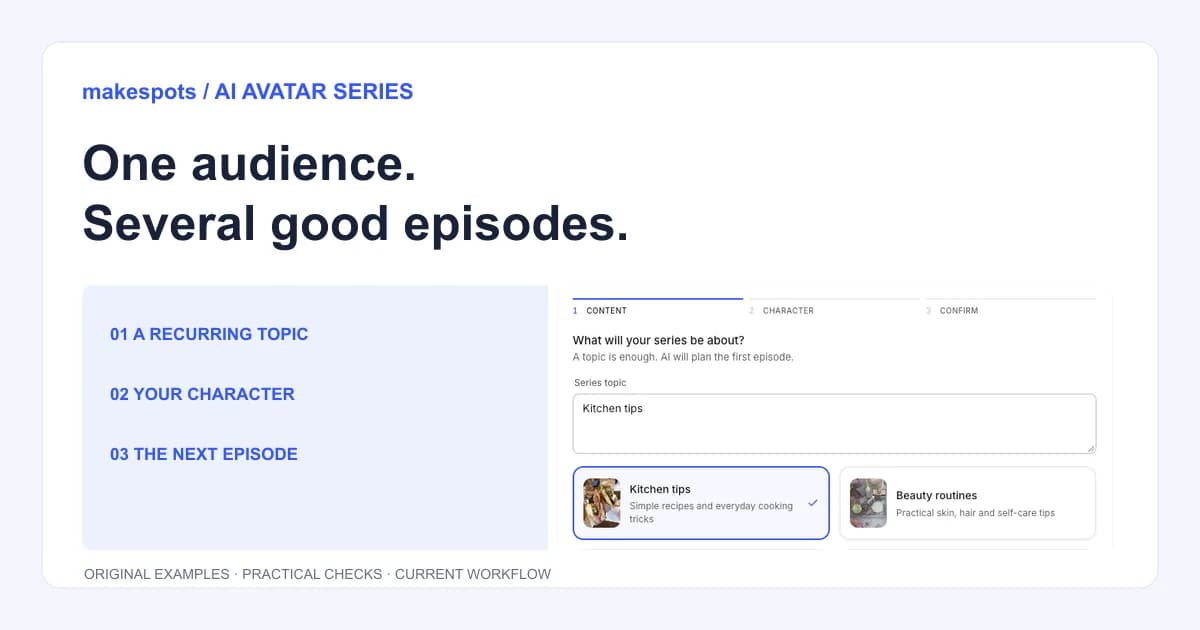
A useful AI avatar series has a specific audience, a recurring presenter and a different payoff in each episode. Pick a format you can fact-check and demonstrate. Plan three distinct episodes, write one complete brief, then review an initial video before committing to a larger queue.
Choose an idea you can verify and show
Look for a repeatable job rather than a category that sounds popular. 'Home' can mean almost anything. 'A fictional host shows one manageable change for a small desk' suggests a setting, an audience and the first few videos. A clear format also tells you when an episode does not belong.
Before choosing, ask what information you can verify, what the presenter needs to show and how much visual complexity the explanation requires. Start with a topic you understand. The easier it is to judge whether the result is right, the more useful your first production review will be.
| If your strength is… | Consider… | Prepare before generating |
|---|---|---|
| Explaining an everyday task | Desk resets or craft-table lessons | One simple action and a visible result |
| Writing clear teaching examples | Phrase practice or software concepts | Verified wording and an original example |
| Knowing a real product or service | A small-business question series | Approved facts, materials and limitations |
| Inventing characters and situations | A fictional story desk | A premise, episode notes and clear fiction framing |
1. The small-space organizing host
Audience: people working or studying in a small room. Presenter: a friendly fictional host at the same ordinary desk. Each episode identifies one small inconvenience and shows a manageable change. The returning space makes the format recognizable without requiring a new set for every subject.
- Episode ideas: The disappearing charging cable; A landing space for tomorrow's notebook; The end-of-day desk reset.
- Production boundary: use a few ordinary objects and one clear movement. Avoid hidden mechanisms, complex assembly and unsupported productivity claims.
2. One phrase for one everyday situation
Audience: adult language learners who want short speaking practice. Presenter: a patient fictional host in a simple room. Teach one useful phrase, explain its meaning and demonstrate a short exchange. Give the viewer time to repeat it instead of turning each episode into a vocabulary list.
- Episode ideas: Asking someone to repeat a sentence; Checking how to pronounce a name; Politely ending a casual conversation.
- Production boundary: verify the usage and pronunciation with a competent speaker or reliable reference. Keep the host's fictional status clear.
3. The craft-table guide
Audience: beginners who want one small creative activity. Presenter: a calm fictional maker at a recurring craft table. Choose an uncomplicated step and explain what the viewer should notice. The format can work as a talking explanation even when the exact hand action needs a separate, carefully reviewed shot.
- Episode ideas: Choosing a paper color pair; Making a clean fold; Planning a simple gift label.
- Production boundary: inspect hand and object motion. Use safe ordinary materials, and avoid presenting an impossible generated action as a workable instruction.
4. A reading companion with one discussion question
Audience: readers who enjoy a focused question after finishing a chapter or story. Presenter: a fictional reading companion beside a small bookshelf. Build an episode around one theme, character decision or writing technique using your own commentary and original examples.
- Episode ideas: What makes an opening inviting?; When does a character earn our trust?; How can a setting change the mood?
- Production boundary: use your own text or material you have the right to quote. Check claims about a real book and signal spoilers when relevant.
5. The small-business question desk
Audience: people deciding whether a real product or service fits their needs. Presenter: a clearly identified fictional guide representing the business, rather than a fabricated customer. Answer a question the business actually receives and show the relevant item or process when you can represent it accurately.
- Episode ideas: What arrives in the starter pack?; Which size fits this use?; How do I prepare before an appointment?
- Production boundary: use approved specifications and current policies. Check product appearance. Do not invent endorsements, customer experiences or results.
6. A plain-language software concept coach
Audience: beginners trying to understand a tool or workflow. Presenter: a friendly fictional coach who explains one concept using a small original example. Keep the lesson useful even if the application changes its button placement. Use a real screen recording when a precise click path is essential.
- Episode ideas: A folder versus a project; What a reusable template saves; Why an exported file differs from an editable project.
- Production boundary: verify current product facts. Do not use generated interface lettering as evidence that a specific control exists.
7. The thoughtful trip-planning companion
Audience: people organizing a short trip who want a calmer planning process. Presenter: a fictional companion at a map or notebook. Discuss a planning decision rather than pretending to report from somewhere the character has visited. The episode can be useful without generating a convincing real-world landmark.
- Episode ideas: Leave room between activities; Make a rainy-day alternative; Keep arrival information in one place.
- Production boundary: verify any real opening hours, prices, access rules or transport advice separately. Do not pass an imagined trip off as first-hand experience.
8. A fictional character's story desk
Audience: viewers who enjoy short original stories. Presenter: an invented letter writer, librarian or night-shift observer with a recurring setting. Let each episode revolve around a new small discovery. A recognizable narrator and location can tie the series together without making every story depend on a long recap.
- Episode ideas: The letter with no address; The library book returned with a note; The key that fits no visible door.
- Production boundary: label fiction clearly. Keep names and story facts in your own notes, and supply continuity explicitly when an episode depends on an earlier event.
Turn the chosen idea into a reusable brief
Describe the audience, returning host, recurring job and the changes allowed between episodes. You can start with the first brief below and adapt the setting to material you can actually review. The brief defines the format; today's exact topic and spoken dialogue belong to the episode.
Mina is a fictional, friendly host who helps people working in a small room organize one desk problem at a time. Keep the same simple desk setting and plain everyday outfit. Each episode starts with a familiar inconvenience, demonstrates one manageable change and ends by showing the result. Use ordinary items. Keep the explanation practical and conversational. Do not promise a transformation in productivity or turn every episode into a shopping recommendation.
Use a different brief for a different kind of series
A fiction series needs different instructions from a practical tutorial. Specify what the narrator knows and which story facts should remain stable. For ongoing stories, keep an episode note outside the brief and provide the relevant context yourself. A recurring avatar does not automatically create a reliable memory of every previous plot event.
Rowan is a fictional librarian who reads an unusual letter at the same wooden desk each evening. Create original, clearly fictional stories for adults who enjoy gentle mysteries. Each episode introduces one letter, explores a surprising detail and gives the moment a satisfying ending. Keep Rowan's appearance and calm delivery consistent. Do not imitate a living person or present the stories as news. Use only the continuity details supplied with the current episode.
Make one complete episode before filling the queue
Write three distinct episode titles and choose the one with the clearest payoff. Decide what the viewer learns or feels, what the host says and what needs to appear on screen. Then create the series, review the script and generate the first episode after checking the quote.
Use that finished video to test the format. Is the subject easy to follow? Does the action work? Does the character suit the tone? Make a different second episode before planning a long queue. Continue when the format produces work you can stand behind, and adapt the idea when the review reveals a better direction.
Common questions
Which AI avatar niche is guaranteed to get views?
None of these ideas guarantees an audience or income. They are production formats with clear tasks and boundaries. Choose a subject you can make useful, review the first episodes and learn from actual audience response rather than treating a niche label as a performance forecast.
Can the same character present several kinds of content?
A saved character can support further episodes, but the audience still needs to understand what the series offers. Keep the initial format clear. When the purpose changes substantially, consider a separate series so its brief and episode queue remain useful.
Do I need to write every episode topic in advance?
No. You can start from the series topic and let the script stage suggest an episode. Planning a few titles yourself helps you check whether the idea has room to grow. Add more topics after creation when you know what the format needs.
Can I use a realistic avatar without filming myself?
You can generate a fictional character or use an authorized portrait as the starting reference. Review the generated face, speech and actions in every episode. Present the character honestly and follow the destination's current requirements for disclosing realistic generated or altered content.
Will the series publish new episodes by itself?
No. The current workflow supports planning, producing, reviewing and downloading episodes. Posting rhythm helps organize the series; it does not automatically publish to a channel. You handle upload, scheduling, destination settings and the final publishing review through your usual tools.
Sources and further reading
Product steps reflect the current Avatar Series workflow. The planning examples are original examples to adapt. Review the current workspace settings and quote before generating.
- Start and reuse an AI Avatar Series
- Generation credits and current plan details
- YouTube: GenAI disclosure requirements
Read the current credit and plan details before budgeting a series.